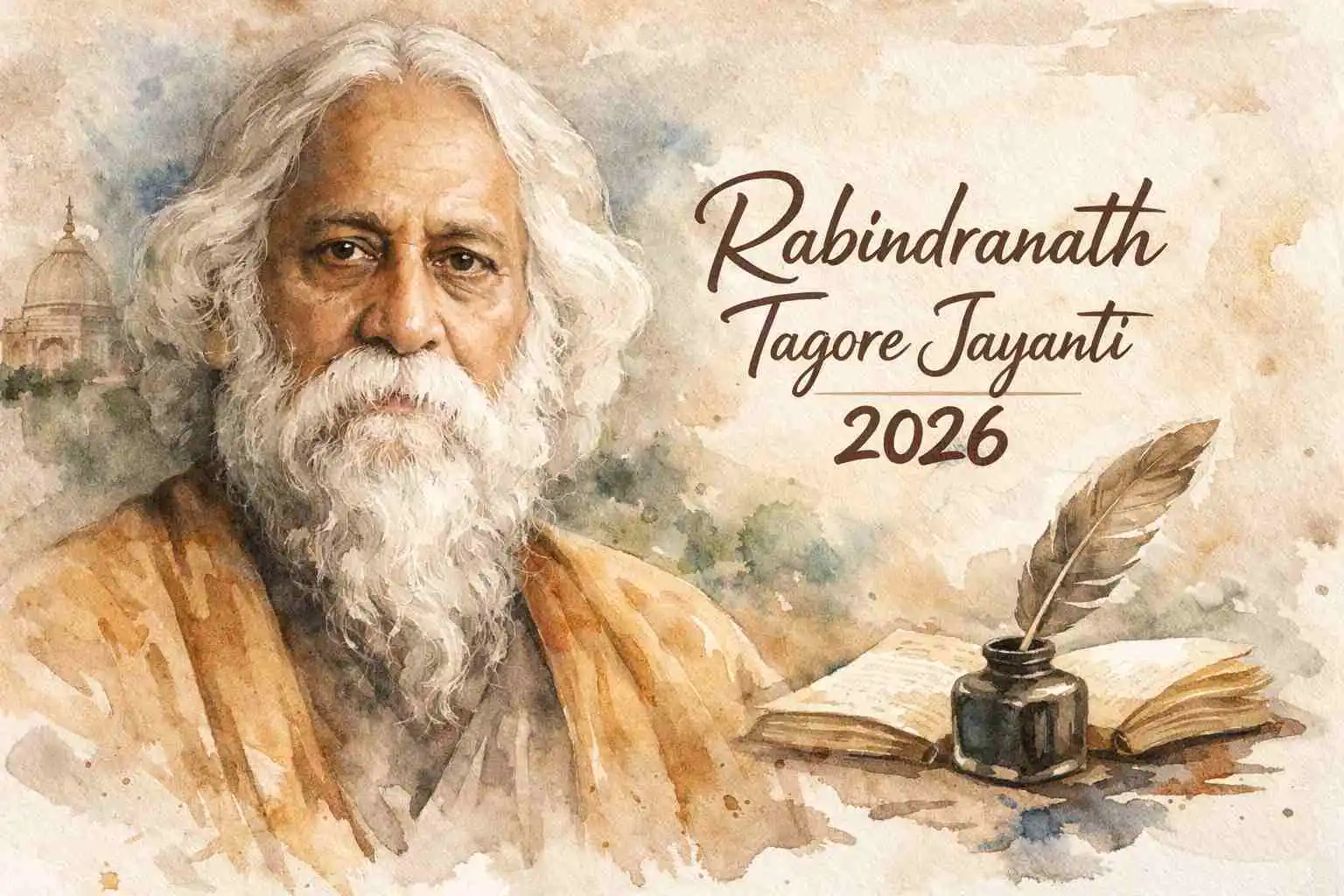
Rabindranath Tagore Jayanti 2026 is a greatly culturally loaded observance which is about celebrating the birth of the greatest literary and philosophical minds that India has ever seen. Rabindranath Tagore Jayanti 2026 will be observed on Thursday, 07th of May 2026 as per the common calendar system. In West Bengal, Rabindranath Tagore Jayanti 2026 will be observed on the 9th of May, 2026.
Why Does Rabindranath Tagore Jayanti 2026 Have Two Dates?
The dual dates of Tagore Jayanti is generally a little confusing to the followers. Rabindranath Tagore was born on May 7, 1861 as per the common Gregorian calendar and this is the official birthday of Tagore Da.
On the other hand, as per the Bengali calendar, Rabindra Nath Tagore was born on 25th day of Boishakh month, in 1422 Bengali Era, which is why in West Bengal this day has more cultural value and is observed as Rabindra Nath Tagore Jayanti.
Rabindranath Tagore is especially loved and admired in West Bengal, and thus this day is celebrated in schools, universities and cultural institutions on the 25th day of Boishakh and is known as Poncheeshe Boishakh. 9th May, 2026 will be marked as Rabindranath Tagore Jayanti 2026.
Rabindranath Tagore Jayanti 2026 which is his 165th birth anniversary is a restricted holiday for many central government offices and a regional holiday in West Bengal. Being a 2nd Saturday, banks will remain closed.
Rabindranath Tagore: Early Life and Background
Rabindranath Tagore was born on May 7, 1861, in Kolkata (then Calcutta) illustrious Tagore (Thakur) family of Kolkata. His family was well known because of their contributions to literature, music, art and social reform. His father, Debendranath Tagore, was a leading figure of the Brahmo Samaj, which promoted spiritual monotheism and social reform in 19th-century India. His mother, Sarada Devi, managed the large household but passed away when Tagore was still young.
Growing up in such an intellectually vibrant environment had a deep influence on Tagore’s creative and philosophical development.
In 1883, Tagore married Mrinalini Devi (born Bhabatarini). The couple had five children—two sons and three daughters. However, his personal life was marked by deep sorrow. He lost his wife in 1902, his daughter Renuka in 1903, and his youngest son Samindranath in 1907. These tragedies profoundly affected him and found expression in his later works, which often reflect themes of loss, spirituality, and resilience.
Rabindranath Tagore passed away on August 7, 1941, at his ancestral home, Jorasanko Thakur Bari, located in Kolkata, West Bengal, India. This historic residence, where he was also born, remains a place of great cultural importance and has since been converted into a museum dedicated to his life and legacy
Rabindranath Tagore Jayanti 2026: Literary Works and Achievements
Tagore’s contribution to literature is vast and timeless. He was a poet, novelist, playwright, composer and philosopher. His most celebrated work, Gitanjali (Song Offerings), earned him the Nobel Prize in Literature in 1913, making him the first non-European to receive this honor.
He also wrote India’s national anthem, Jana Gana Mana, and Bangladesh’s national anthem, “Amar Sonar Bangla.” Some of his other notable works include:
- Ghare-Baire (The Home and the World)
- Gora
- Chokher Bali
- Numerous songs collectively known as Rabindra Sangeet
Ideologies and Philosophy of Gurudev Rabindranath Tagore
Tagore’s ideologies were rooted in humanity, universalism, and harmony with nature. He was the biggest advocate of India’s Freedom but never rooted for aggressive nationalism, advocating instead for global cooperation and mutual respect.
He did not believe in formal schooling and studied at home. By the time he turned eight, he had already started writing poetry and by sixteen, he published his first substantial works. He said education is very important as it enhances creativity and all round approach to life.
Know more about Lifetime and Legacy on Rabindranath Tagore Jayanti 2026
Rabindranath Tagore lived a rich and impactful life until his death. Over his 80 years, he reshaped literature, music, education, culture and philosophy not just in India but all around the globe.
His legacy continues to thrive through:
- Annual cultural programs on Tagore Jayanti
- Performances of Rabindra Sangeet
- Literary readings and discussions
- Educational institutions inspired by his ideals
Conclusion
Rabindranath Tagore Jayanti 2026 is a reminder of a visionary who literally was beyond geographical limits and his works reached each nook and corner. Let us all honour the man whose legacy continues to inspire generations and teaches us to think freely, feel deeply and live harmoniously with the world around us.
1 thought on “Rabindranath Tagore Jayanti 2026 & His Vision That Still Inspire Millions: Know Why India Celebrates Him on Two Different Dates”