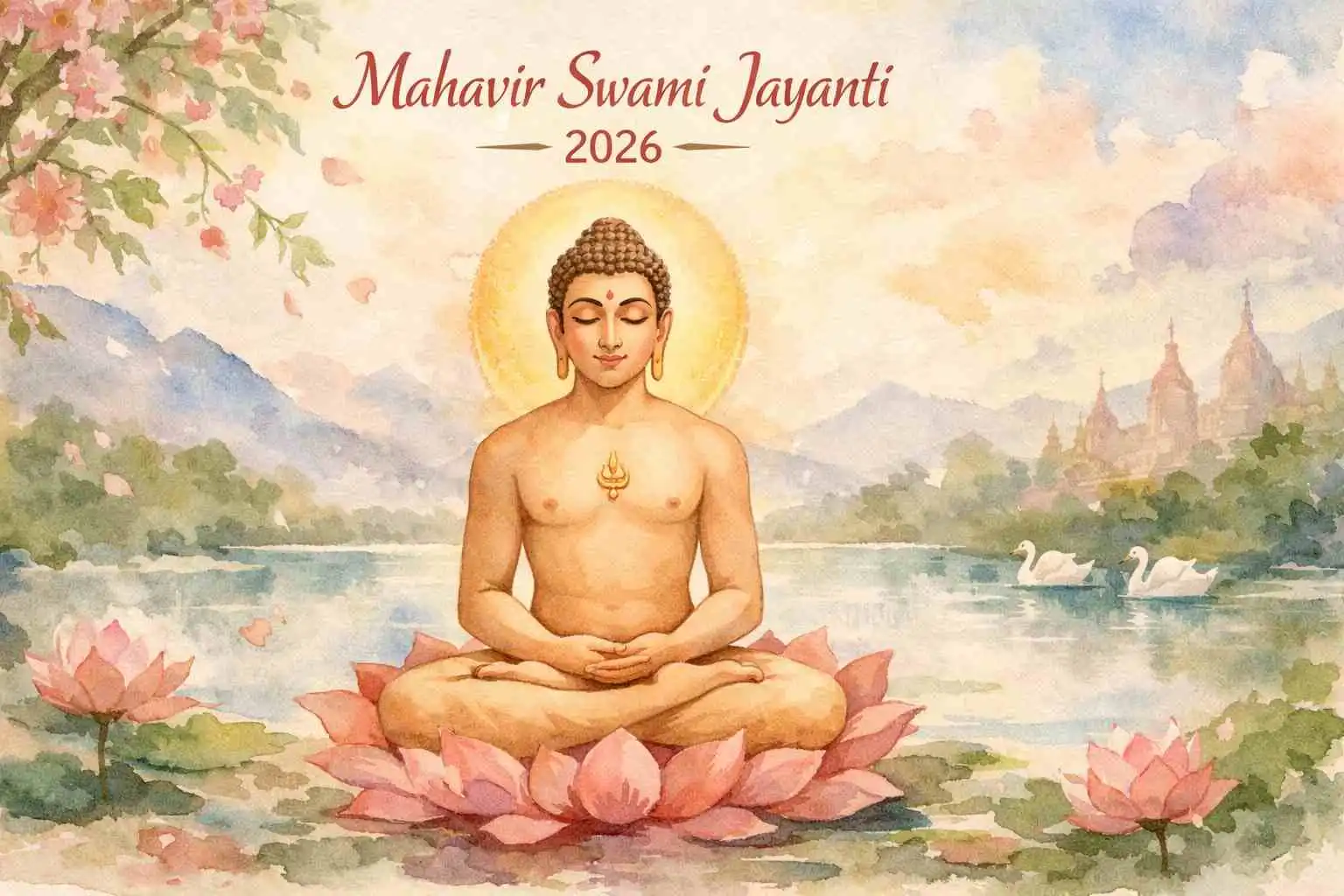
Mahavir Swami Jayanti 2026, the biggest day Jain religion is about to be observed with deep emotion and full devotion. The day is observed on the thirteenth day or Trayodashi which is two days before the Chaitra Purnima. This day is celebrated in various ways all across the earth with unwavering faith and devotion and great understanding of humanity.
Mahavir Swami Jayanti 2026 Date
| Mahavir Swami Jayanti Date | Tuesday, 31st March, 2026 |
| Trayodashi Tithi Start Time | 07:09 AM on March 30th, 2026 |
| Trayodashi Tithi End Time | 06:55 AM on March 31st, 2026 |
Devotees across India and globally celebrate this day with great devotion, visiting temples, participating in processions, and engaging in acts of charity. It is a gazetted holiday in India, with schools, banks and government offices. He is also known as Vardhman Mahavir.
Early Life of Mahavir Swami
In 599 BC in Kundagrama which is the present-day Bihar in a Royal family to King Siddhartha and Queen Trishala Mahavir was born. Since his childhood his parents had started seeing signs of extreme wisdom and spirituality.
Since early childhood, Mahavira was very courageous, had too much valour, was very disciplined both in life and spirituality and was into introspection. Although he was a royal, he was never interested in worldly pleasures and money. When he turned 30, he gave up and relinquished his royalty and kingly life and went away in search of the real truth. This was the start of his path to enlightenment.
After spending 12 years doing deep meditation and atonement till he achieved Kevala Jnana or omniscience and become a Tirthankara. Tirthankar is a spiritual Guru who teaches the followers the path of liberation.
Mahavir Swami Jayanti 2026: History and Significance
Mahavir Swami Jayanti 2026 is about honoring the birth of a Tirthankara who gave a whole new meaning to ethical and simple living and high thinking. The teachings of Bhagwan Mahavir are not a new concept but they revived and gave a fresh and new start to the earlier taught Jain teachings.
The life of Bhagwan Mahavira was a crucial stage in the rise of Jainism as he stressed upon choosing and living a disciplined path to liberation or Moksha by following the journey of restraint, empathy and detachment.
Mahavir Swami Jayanti 2026 will be celebrated with:
- Rath Yatras or Shobha Yatra : Magnificent processions with beautifully decorated Raths where Murti of Bhagwan Mahavir is kept is carried out, whilst the followers sing bhajans all along.
- Abhishek : Ritual bathing is done with milk and water and thereafter flowers are offered and fruits and rice sweets are offered.
- Charity and donation: Donating food, clothes and money to the needy and poor.
- Spiritual Sermons : Seminars are organized with Bhagwan Mahavir’s teachings are recited the value of inculcating them in today’s times explained.
- Upwas & Meditation : Doing Vrat and meditating are a part of the cleansing of body and mind on the occasion of Mahavir Swami Jayanti 2026 to attain spiritual discipline.
Core Teachings of Mahavir Swami
The philosophy of Mahavira revolves around five fundamental principles, also known as the Panch Mahavratas:
1. Ahimsa (Non-violence)
The cornerstone of Jain philosophy, Ahimsa teaches complete non-violence in thought, word and action towards all living beings.
2. Satya (Truth)
Always speak the truth, but in a way that does not harm others. Truth must be practiced with compassion.
3. Asteya (Non-stealing)
Do not take anything that is not willingly given. This extends beyond material possessions to respect others’ rights and boundaries.
4. Brahmacharya (Celibacy/Chastity)
Control of desires and practicing self-discipline to achieve spiritual growth.
5. Aparigraha (Non-attachment)
Detach from material possessions and desires to attain inner peace and freedom.
About Jainism
Jainism is one of the oldest religions in the world, originating in India over 2,500 years ago. It focuses on achieving liberation (moksha) through self-discipline and purification of the soul.
Key Beliefs:
- Karma Theory: Every action has consequences that bind the soul
- Reincarnation: The cycle of birth and death continues until liberation
- Non-violence: The highest religious duty
- Asceticism: Renunciation of worldly pleasures for spiritual progress
- Jainism does not believe in a creator god; instead, it emphasizes self-effort in achieving enlightenment.
Relevance in Modern Life
The teachings of Mahavira are more meaningful today as the values of non-violence, minimalism and truthfulness pave a way for ethical living.
On the occasion of Mahavir Swami Jayanti 2026, if one follows even some of his teachings today’s stressful, digital media oriented life will become so much easier . One can feel the huge change that it will bring.
Conclusion
Mahavir Swami Jayanti 2026 is a very—it is a powerful reminder of the timeless values of compassion, discipline, and inner peace. The life of Mahavira inspires millions to walk the path of righteousness and self-realization.