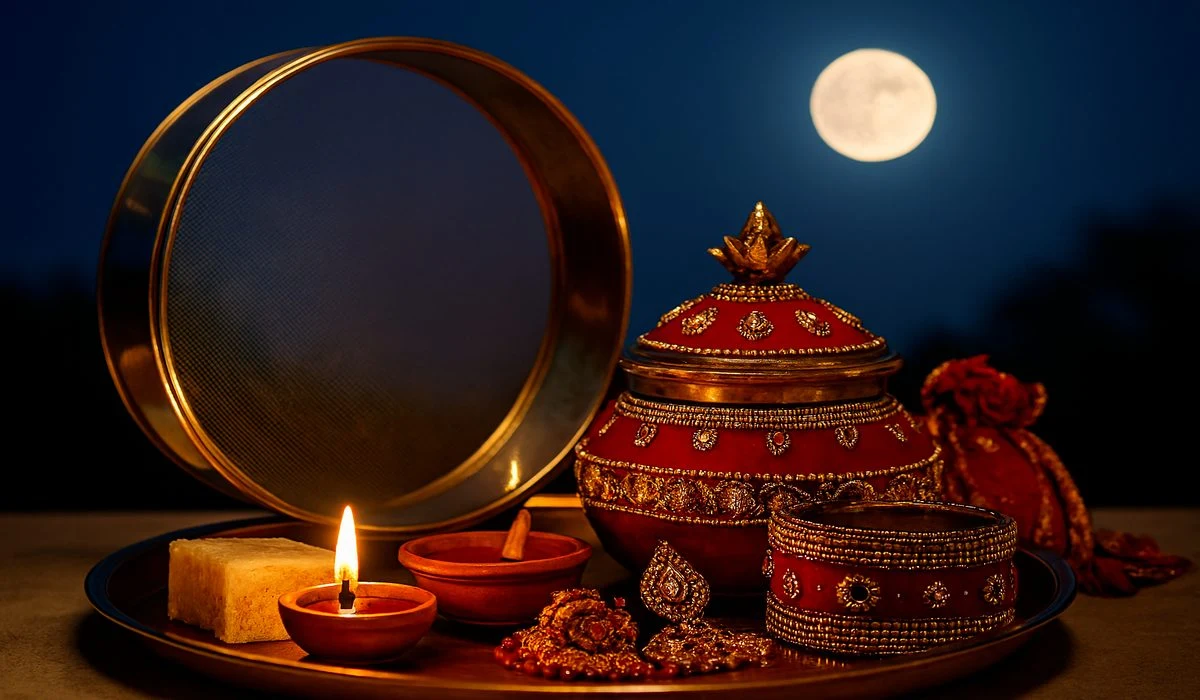
Karwa Chauth 2025 is just around the weekend and everyone observing it needs to know all about the Karwa Chauth rituals Let’s look at all the Karwa Chauth rituals (Puja Vidhi), the auspicious puja muhurat and detailed list of puja samagri (items needed to perform Puja) and everything else which is needed to observe and perform this festival in the most pious and proper way.
Earlier Karwa Chauth was mostly observed in the northern states of India like Delhi, Punjab, Haryana, Uttar Pradesh, and Rajasthan but nowadays women across India and even many other parts of the world observe this sacred festival. Karwa Chauth rituals mainly consist of women observing fast which goes on from sunrise to moon rise. This day long fast is a Nirjala Vrat where the women observing this festival do not eat or have water for the whole day to ensure that their husbands get the boon of longevity of life, good health and also prosperity and wealth.
Karwa Chauth rituals and customs do not just have a matrimonial symbolism, but it is also a time for family and communal love, spiritual connection and enlightenment, faith and dedication.
This year Karwa Chauth is being observed on Friday, the 10th of October. Let us know more about the Karwa Chauth rituals, puja muhurat, puja vidhi, and the puja samagri for performing the puja in its glorious form.
Karwa Chauth 2025 Puja Muhurat (Sacred auspicious timing to perform Puja)
As per the Karwa Chauth rituals and customs, the Puja is executed every year in the evening which is also known as Chandrodaya Vyapini Chaturthi in Sanskrit. Chaturthi is the fourth day as per lunar placement and Chandrodaya Vyapini mean the time when the moon is about to rise. .
- Shubh Muhurat for Karva Chauth Puja: 5.57 PM to 7.11 PM on 10th October, 2025
- Expected time of Moonrise: 8:13 PM approximately in Delhi, Noida, Gurugram, Faridabad, Greater Noida
- Moonrise time in Chandigarh, Punjab, Jammu, and Ludhiana: Around 8:08 to 8:11 PM.
- Moonrise time in : Dehradun around 8:04 PM, in Shimla around 8:06 PM, in Patna by 7:48 PM, in Kolkata at 7:41 PM, Lucknow and Prayagraj around 8:02 PM, Jaipur around 8:22 PM, Indore at 8:33 PM, Bhopal at 8:26 PM, Ahmedabad around 8:47 PM, in Mumbai around 8:55 PM, Chennai at 8:37 PM, Bengaluru around 8:48 PM and Hyderabad at 8:36 PM.
- Auspicious duration of performing Puja : Around 1 hour and 14 min
As the Puja timings are based on the moon rise time in that area, anyone observing the fast and other Karwa Chauth rituals may consult the internet and Drig Panchang for accurate timing in your area.
Karwa Chauth Puja Samagri (List of Items Required) required to perform all the Karwa Chauth rituals
Anyone observing Karva Chauth this year is advised to prepare in advance all the puja samagri which will ascertain that Puja is performed smoothly and there is no last minute rush. This will help the devotees to concentrate on the divine meaning behind this auspicious occasion. Following is the list of all essentials required:
1. Items for Puja Thali during Karwa Chauth rituals :
- Karwa (earthen or brass pot with lid and a small opening or hole at the side)
- Diya (lamp), ghee, and batti (cotton wicks)
- Agarbatti (Incense sticks) and kapoor (camphor)
- Flowers
- Chandan (sandalwood), haldi (turmeric), kumkum (vermilion), and akshat (rice grains)
- Kalash (copper or brass pot) filled with water with five leaved mango and a coconut
- A sieve (chhalni / chalni), which is used to look at the moon and thereafter the husband.
- Pooja chowki or altar for worship
2. Offering to be presented to God while performing Karwa Chauth rituals:
- Milk, curd, ghee, sugar, and honey ( Panchamrit items)
- Fruits, sweets, and dry fruits like makhana, kishmish, cashew
- Poori (fried dough balls) and halwa (sweet pudding) prepared at home
- Paan, Supari (Betel leaves, betel nuts) and coins
3. Suhag or Shringaar/ Shringar (Marital)samagri or items for Karwa Chauth rituals:
- Sindoor (vermilion), Choodiyan (bangles), mehendi (henna), bindi, comb, and red chunri
- Solah Shringaar Jewelry like anklets, maangtika, baajuband, necklace, earrings, bichhiya and traditional attire (preferably red or pink saree/suit)
- Dakshina (offering money) for giving to Pandit Ji and Mother-in-Law or any other older ladies at home
Karwa Chauth rituals and Puja Vidhi
1. Sargi
Sargi is a pre-moonrise Karwa Chauth rituals. Women get up really early, that is way before sunrise and after taking bath and doing Puja they eat Sargi. It is a energy giving meal which is generally prepared by mother-in-law or has items which are given by her to the daughter-in-law like fruits, dry fruits like banana, sweets, meethi matthi / meethi mathri and several other dishes like seviyan (vermicelli) and meethe parathe.
Then the followers take a vow (sankalp) to Karwa Mata and Paravati Mata that they will fast and worship with full devotion on this day for longevity of their husband’s life, his health and his prosperity.
2. Nirjala Vrat (Nirjal Vrat)
Nirjala Vrat or Daylong Fast is one of the most pious Karwa Chauth rituals. Women fast without any food and water for the whole day and pray and worship for the well being of their husbands.
The fast starts from sunrise and continues till moonrise.
3. Puja ki taiyyari (Puja preparations)
Those observing the fast get dolled up in traditional attires like saree, suits, lehengas in bridal hues of red and punk. Some even wear their wedding dress as part of Karwa Chauth rituals.
Puja thali is decorated with all the items which is then kept in front of Karwa Mata and Lord Shiva and Goddess Parvati to be blessed by them.
4. Karwa Chauth Puja Rituals
- A picture of Karwa Mata, and Mata Parwati and Lord Shiva is placed on the altar.
- All offerings as mentioned above and Karwa to be presented before the Gods.
- Kalash is filled with holy water as a sign of bountiful blessings.
- Suhag ka Saaman or Shringar ka samaan (reperesentative jeweller, chunri, henna, bindi, vermillion, etc) to be [resented to Karwa Mata.
- Karwa should either be water, milk, wheat or rice as per tradition followed in your family.
- Worship to the deity for husband’s long life, health, wealth, peace and prosperity.
- Karwa Chauth Vrat Katha which is the saga of Queen Veeravati should be heard or listened. Her story is the symbolic emblem of faith, devotion, dedication and love towards your husband and towards the almighty. This is generally done in groups.
5. Moonrise and Arghya
After the Puja is completed, women wait for the moon rise. Once the moon is visible, then:
- The arti thali which was presented to Mata for blessings to be brought and the diya (earthen lamp) should be lighted.
- Then do not look directly at the moon, rather look at it through the sieve, and then look at your husband through the sieve, this symbolizes that your husband is no less than divine for you.
- Argha or Arghya (offer water from kalash or lota or pot) and holy rice should be offered to the moon while continuously wishing well for your husband.
- Seek blessings
- Husbands should then offer water to their wives in order to break their fast and complete the puja. Any sweet can also be offered in addition to water.
- The whole family should then sit together and have prashad and dinner and thank the Gods for their soulful blessings.
Conclusion
Karwa Chauth and Karwa Chauth rituals are not just customs but they are an expression of love of married couples. While the wives fast for their husbands, the husbands help the wives in household chores and let them rest. They even pamper their wives with gifts. On this day, a husband can see the sacrifice which a wife undergoes for the well being of her busband, which make stheir bond eternal.
On the 10th of October 2025 i.e. on Karwa Chauth 2025 let us all take this opportunity to celebrate and honour our families and thank Lord Shiva and Mata Parvati for this blissful family bonding. Karwa Chauth is truly a reflection of the beautiful and diverse Indian culture and values.
1 thought on “Karwa Chauth Rituals and Vidhi, Puja Muhurat & Complete Puja Samagri List: All in one place, करवा चौथ की रात कब निकलेगा चाँद, यहाँ जानें”